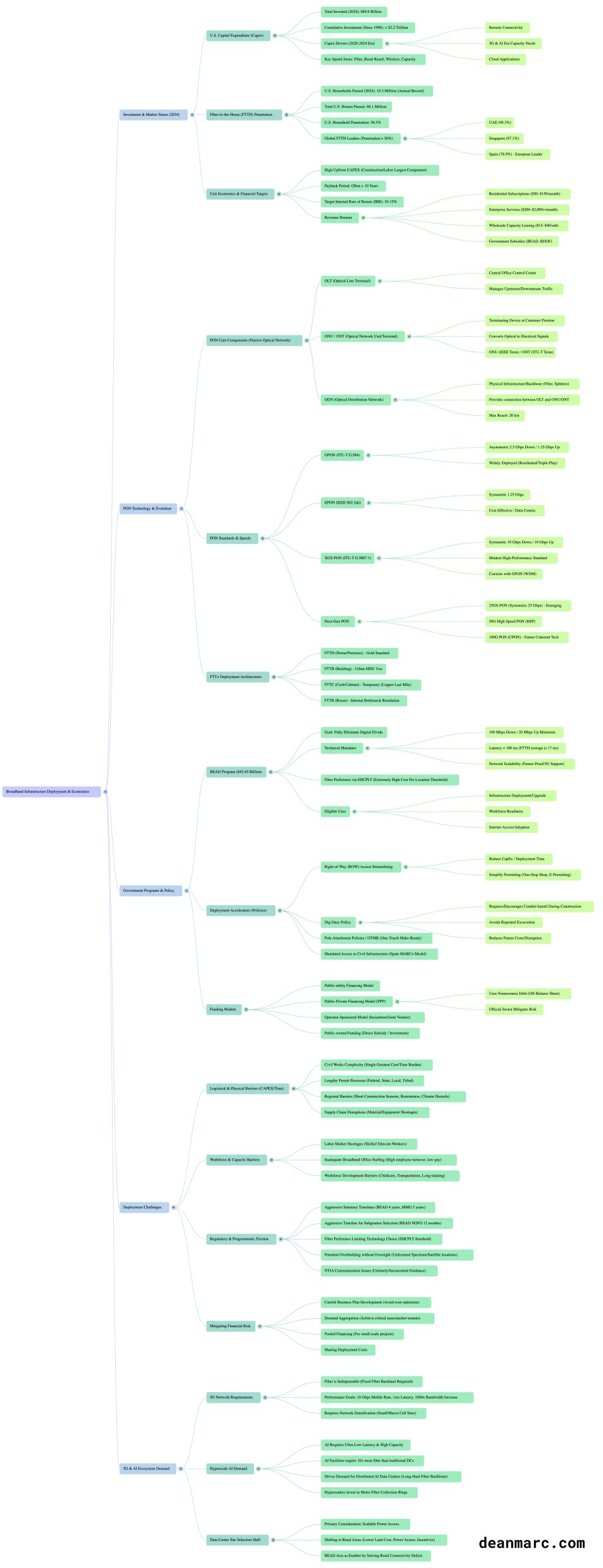
Broadband infrastructure economics is fundamentally defined by the tension between high-CAPEX civil works and population density, where the Cost Per Premise Passed (CPPP) dictates the financial viability of deployment. While Fiber to the Home (FTTH) represents the gold standard—offering effectively unlimited bandwidth and low long-term OPEX despite high initial construction costs ($1,000–$2,500+ per home)—incumbent Cable (DOCSIS) and lower-cost Fixed Wireless Access (FWA) serve as critical bridging technologies that trade longevity for speed of deployment. The “last mile” remains the primary financial bottleneck; in rural zones where subscriber revenue cannot amortize the investment, “market failure” necessitates government intervention through gap-funding subsidies (such as the U.S. BEAD program) to treat connectivity as a utility. Ultimately, the sector is currently characterized by a “land grab” for natural monopolies, creating a sharp bifurcation between future-proof fiber assets and capacity-constrained wireless solutions.